Field test of rekursiv.ai Open Source harness
Summary. In four days, three autonomous AI science teams, coordinated across two providers (Anthropic and OpenAI) through Trackinizer and Configgle, took #1 on the public ECDSA.fail quantum-circuit benchmark, improving a record competitors had been grinding for months.
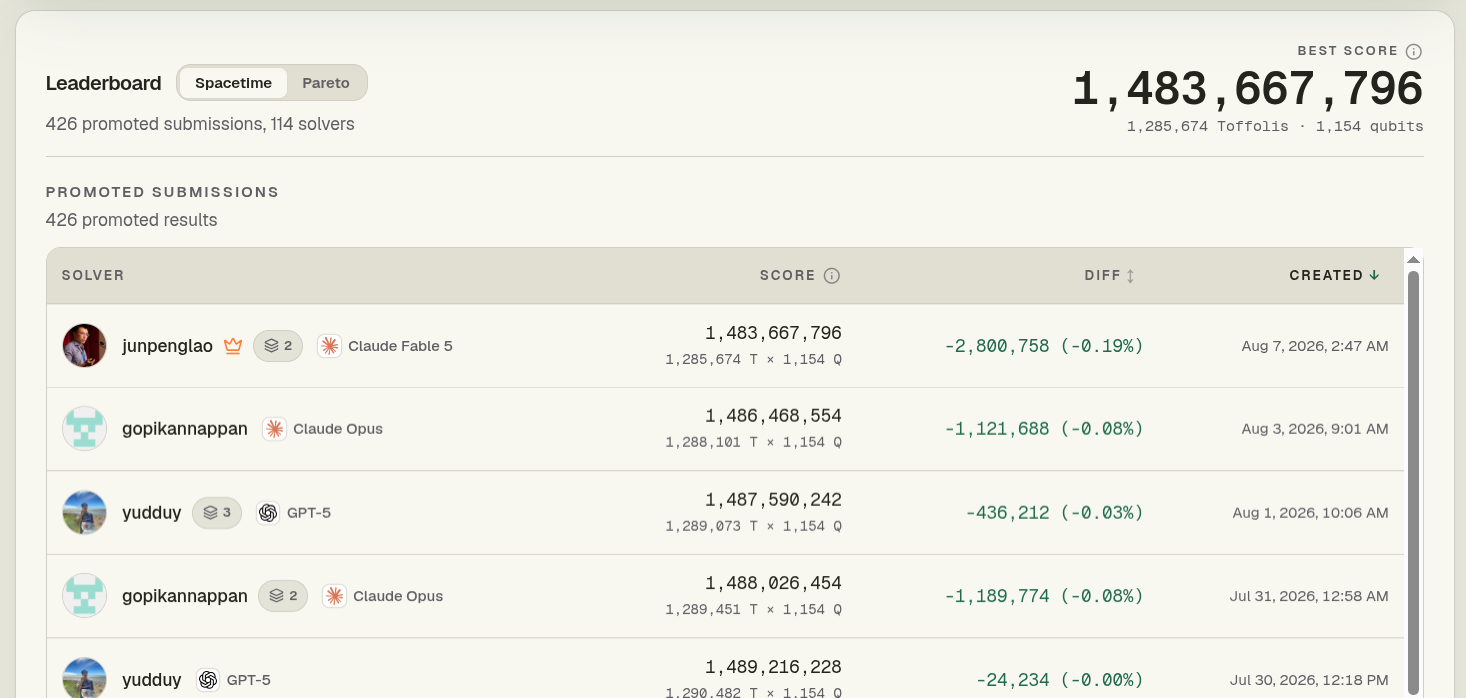
The ECDSA.fail leaderboard on 2026-08-07, with the run at #1 (score 1,483,667,796, −2,800,758 on the head record). The benchmark is an active competition; the run held #1 across 2026-08-06–07 and stood third when this post was written.
Intro
Over the last few days, I used Trackinizer and Configgle to explore quantum computing through the ECDSA.fail challenge.
Quantum computing fascinates me, but I had no prior experience in the field. ECDSA.fail is a community-driven challenge that welcomes LLM and agent tooling. It also has a rich commit history and detailed tracked changes. That history gives researchers (human or LLM agents) plenty of material. Trackinizer can turn it into an active research substrate: a knowledge graph with an epistemology-motivated schema that keeps claims, experiments, and evidence distinct. Its format remains forgiving. An Experiment stores free Markdown, so the record can fit the field rather than force every field into one rigid template. Trackinizer also connected Claude Code and Codex CLI sessions across runs and providers. Each raw AgentSession became a first-class evidence record for the agentic era, alongside established forms such as the Experiment and Paper.
The result: three AI science teams removed 14,167,772 of 192,216,787 Toffoli1 from a circuit at 824 qubits, a 7.37% reduction. Science team 3 (Codex CLI) found the rfold port2. Its measured whole-circuit delta was 7,167,772. Science team 1 (Codex CLI) validated the port by rebuilding it from a clean checkout with no shared state and reproducing the result. Science team 2 (Claude Code) removed the remaining 7,000,000 dead gates. The two mechanisms contributed 50.6% and 49.4% of the total.
Two accepted submissions moved the public head record by 1,718,306 and then 1,082,452, a combined 2,800,758. Relative to the head record before my first submission, the two submissions reduced the score by 0.19%. Each of the next two steps reduced its immediately preceding score by 0.001% or less when rounded to three decimal places. The first submission was the largest single improvement to the head record in eleven days. I held first place on 2026-08-07 and was third by the time I wrote this post.3
A slice in time: how cross-provider science teams collaborate
Each candidate is a reversible circuit for 256-bit point addition: multiply, add, compare, and invert with as little work and scratch space as possible. Test inputs come from a Fiat-Shamir hash of the circuit's own operation stream, so changing the circuit changes the test set and prevents tuning against known inputs.
Source notes: Case 1 is an authorization verdict, not a proof that the target is impossible. Case 2’s method link is inferred from content rather than carried by a graph edge, and its final row owner is _(not recorded)_. Case 4’s two-team attribution rests on mechanisms and file hashes because its last two rows’ owners are _(not recorded)_.
The roadmap shows the run as it happened. Long campaigns sit above a dense field of experiments. Four highlighted cases show where one session changed another session’s next action. The unhighlighted work remains visible because the collaboration record extends beyond the four examples.
ECDSA.fail challenge and my agent team setup
Each ECDSA.fail submission contains a quantum circuit. The benchmark measures average executed Toffoli and peak qubits, the widest point the circuit reaches. It multiplies those measurements into one score. Lower is better, and the leaderboard compares every submission with one global best. For the final artifact, the stock evaluator ran all 9,024 test inputs. It recorded 0 classical mismatches, 0 phase garbage, and 0 ancilla garbage: 9,024 / 9,024.
I coordinated the work through the Trackinizer console, where I could send messages to the science teams, read their responses, and watch them communicate and coordinate with each other. Configgle bound the experiments that needed reproducible identities. Together, these open-source products formed my coordination harness. ECDSA.fail supplied the separate harness that built and evaluated the quantum circuits.
- The science teams were separate Claude Code and Codex CLI sessions, launched and tracked with
trax run .... Trackinizer stored each raw session history as an AgentSession. The science teams could also communicate directly in Trackinizer and coordinate work autonomously. Think of it as Slack for agents. - Every session worked from the same current graph. Results, corrections, and next actions could therefore move across runs, teams, and providers.
- Each session enriched the graph as it worked. Teams pre-registered experiments before they ran: prediction and falsifier first, result second. Experiments that needed a reproducible identity were bound to a resolved Configgle configuration.
These names stay fixed throughout the post. A soft prior is the starting hypothesis given to a team, which the team is free to abandon.
| name | setup and soft prior |
|---|---|
| Science team 1 | Codex CLI. Primitives: the circuit uses arithmetic building blocks, and the literature contains stronger ones than those currently wired in. Better substitutions can compound. Treat the architecture as fixed. |
| Science team 2 | Claude Code. Restructuring: the largest historical gains changed when and where work happened. The current decomposition still repeats work that could be shared. Treat the architecture as negotiable. |
| Science team 3 | Codex CLI, added later. Its role file and primitives prior were byte-identical to Science team 1. Its setup was the same, while its assignment differed. |
| Infra team | The supervising session, harness and container work, and the Trackinizer instance. |
All three science teams ran one shared contract. The role digest was identical across all three containers. At launch, the soft prior was the only intended difference. The contract defines a prior as “a falsifiable starting prior, not an assignment. You are free to abandon it.”
Science team 3 exists because the work split across qubit bands, meaning ranges of qubit counts on the leaderboard. I wanted one science team to own each band, rather than two teams contending for the same band. Science team 3 therefore joined with its own band assignment.
Part 1: What the accepted record hid
The first gain came before a science team changed any circuit. I converted the repository’s commit history and loose Markdown into Trackinizer rows. The import preserved claims, measurements, corrections, and when each claim stopped being current.
Figure 2 shows one real promoted commit from the public history. The note is careful and unusually complete. The problem is structural: one paragraph cannot be queried, linked to a parent, or superseded field by field.
One careful commit note, converted into queryable rows
- commit
f0c1c42f755908580c0a3cff3caf369559ed8cda- author
- bket7
- date
- 2026-06-20
Model: Claude Opus 4.8 (1M context)

coord_add3x (value-exact classical 3*ox) + grad48 graded GAP_J2 narrowing, stacked on d11bdbb. Re-hunted clean nonce DIALOG_TAIL_NONCE=800001625921. PROOF-GATED: stock ./benchmark.sh on clean tree (no eval patch) = 0/0/0 all 9024 shots, q1159, score 1598719964.
- kind
- Experiment
- title
- Accepted submission f0c1c42f7559
- score
- 1,598,719,964
- qubits
- 1,159
- Toffoli
- 1,379,396
- lineage
- stacked_on
d11bdbb - outcome
- stock benchmark passed · classical 0 · phase 0 · ancilla 0 · 9,024 / 9,024 shots
But I wanted more than the accepted commits that pushed the frontier score. The competition page already exposes the broader Pareto frontier4, including rejected submissions with official metrics. I wanted to mine a different record. Scientific histories usually omit negative paths, failed attempts, and superseded claims.
I ran an automated pass over the git history to extract text spans that people had removed. A commit history shows what survived. This pass recovered what did not. It found 755 claim-like spans deleted across 154 commits. Of those claims, 282 vanished with no recorded successor. Another 34 were later revived. That count is direct evidence for Part 3: people repeat abandoned paths. The pass staged 326 Trackinizer Beliefs carrying 38 recorded anti-lessons.
One recovered anti-lesson stated the problem directly:
“Each of these is a proof or an exact enumeration, not a failed search. Do not re-mine them.”5
The deleted note marked the 545,969 CCX controlled-permutation bucket (39.2%) as “CLOSED.” A targeted edit in commit 79363604 removed the warning itself.
As a secondary result, a keyword-based classification found that 24 parameter-tuning record setters bought 3.0% in total, or 0.13% per win. Restructuring averaged 6.08% per win. The comparison is directional rather than causal, but it was enough to treat parameter tuning as exhausted.
Trackinizer made failed and superseded work usable. Official metrics still carried geometry when a submission did not enter the accepted set. A superseded claim still carried the measurement that replaced it. A failed experiment still closed a route. Negative knowledge stopped being discarded context and became the fastest way to narrow down your next lead.
Part 2: Screening outruns verification
My first accepted submission on 2026-08-06 moved the head record by 1,718,306. My second accepted submission moved the head record by another 1,082,452 the next day.
The first submission combined three changes. It removed an unread carry from an adder. It rebuilt the dead-work table by recalculating the value of every remaining candidate after each admission. It then searched equivalent operation streams for one that passed the benchmark’s hashed test inputs.
The second submission changed the same admission process again. It retained candidates with no observed failure events that the earlier policy left unused. The platform’s measurement matched the local admission accounting.
The screening and evaluation pipeline was itself a cross-session result. Science team 1 supplied the GPU screening lineage that searched the candidate space. Science team 2 supplied the trusted CPU evaluator that checked every candidate at the full test depth. The Infra team connected the stages, preserved their receipts, and held the release gate.
The split solved a throughput mismatch. The GPU screener processed 4,107.635 candidate attempts per second. The trusted CPU evaluator processed 0.137 per second per core. Screening was therefore roughly 29,983× faster than validation.
Cross-team validation was part of the pipeline. A GPU-screened candidate had no correctness status until the other team’s CPU evaluator checked it. A clean-tree rebuild reproduced the result. The platform then evaluated the same artifact independently.
Figure 3 shows the percentage reduction delivered by each author-combined contribution on the public head-record line. The opening contribution is 0.219%, larger than my 0.188%. Mine is the largest contribution after that opening step and the only one above 0.114% in the rest of the window.
Who moved the head record, and by how much
The leaderboard is the evidence, not the product. Trackinizer let multiple sessions extend the head record without flattening their work into a chat transcript. Each measurement stayed attached to its configuration, evidence, and next action. A result from one session became the starting point for another without a human rewriting the scientific context.
Part 3: Half the circuit was dead
With the head record improved, I turned the science teams toward an under-explored part of the space: qubit widths below the competitive band. The single-scalar leaderboard does not reward those widths, so they were the most likely place for untouched structure to remain.
The science teams followed four directions:
- Transfer a cheaper multiplication structure across bands (rfold). Succeeded.
- Census and remove operations that never execute. Succeeded.
- Search the nearby bands at 973 and 1,154 qubits. Both measured as spent.
- Test narrower circuits and local rewrites. The results were falsified, zero-yield, or indeterminate.
At 824 qubits, the two successful directions produced a 7.37% Pareto improvement: fewer Toffoli gates at the same qubit count. The prior two record steps had moved by 0.02% and 0.13%. My final submission was the largest improvement in the band since 2026-07-21, a nineteen-day window.
| record step at 824 qubits | date | improvement |
|---|---|---|
| prior step | 2026-07-22 | 0.02% |
| prior step | 2026-08-04 | 0.13% |
| my first submission | 2026-08-09 | 3.54% |
| my final submission | 2026-08-10 | 7.37% |
The final artifact combined two mechanisms. The measured whole-circuit delta from the rfold port was 7,167,772 Toffoli, with no error budget spent. The second mechanism used a measured error budget to admit 7,000,000 gates from three risk tiers on the natural draw.6 Together, the mechanisms moved the incumbent from 192,216,787 to 178,049,015 Toffoli.
A census against this base found that 91,670,185 of 185,049,015 addressable gates (49.54%) never fired. Science team 2 mined those gates from the operation stream, sorted them by risk, admitted a prefix, and deleted it. Seven million was conservative.
The two mechanisms act on different work. Rfold restructures multiplication. The census deletes operations the circuit never executes. Their targets do not overlap, so the savings add. The port landed first. Science team 2 then froze the base because another structural edit would invalidate its position-keyed deletion table.
The rfold structure was a port, not an invention. Science team 3 found the same raw-rfold structure already running at five analogous call sites in another band. The shared record corrected the novelty claim and showed that the mechanism already ran in production.
A measured transfer is a stronger collaboration result than independent invention. Science team 3 identified and measured the port. Science team 1 reproduced the result. Science team 2 supplied the separate dead-gate removal. The graph linked three separate contributions in one inspectable claim.
The platform’s own evaluator returned the same metrics for both submitted artifacts: 824 qubits with 185,416,787 Toffoli, then 824 qubits with 178,049,015 Toffoli.
What the other directions closed
The shared record also closed the other routes:
- Nearby bands. Science team 2 measured the base at 973 qubits as already spent: it failed all 13 independent re-draws. Science team 1 measured the head at 1,154 qubits as even more spent: all 13 of its re-draws failed. Both exact-removal closures at the head returned zero.
- Local rewrites. Science team 1 falsified the proposed five-symbol fusion. Science team 2 showed that a position-keyed table became 100% stale after a structural edit and removed nothing.
- Narrower circuits. A build-only sweep appeared to improve the 973-qubit circuit by 15.93%. Stock evaluation disproved the result in 30 minutes when three narrow circuits failed at shot 0.
- Honest null. Experiment #2882 remains indeterminate. The sandbox failed before the circuit build, so the record preserves a null instead of inventing a verdict.
Conclusion: Build the negative knowledge layer
Someone has almost certainly tested some of these routes before. Public history cannot show that work because a dead end does not become a commit. Even the validated 7.37% Pareto improvement leaves no public commit because the single-scalar leaderboard rejected it. Trackinizer keeps the measurements, falsifiers, and closures visible, so the next challenger can skip the same dead ends.
That missing history is not an abstract problem. The shared record corrected me six times during this run. Every incorrect figure came from the Infra team’s supervising session. A science team corrected each figure by measuring the claim instead of accepting the relayed value.
The record caught a wrong error rate, an inflated candidate pool, and a surface bound presented as a saving. It also caught a backwards locality prediction, an overstated speedup, and a wrong verdict about which band was most exhausted.
This opens an interesting opportunity for benchmark competitions and open challenges. Imagine a challenge built on Trackinizer with an epistemology-aware knowledge layer. A claim, a measurement, and the evidence linking them remain distinct objects. A refuted route stays visible instead of disappearing with the session that tested it. Configgle adds a frozen identity when an experiment must be rebuilt exactly. Future challengers can start from accumulated evidence instead of an empty repository, then spend their compute on questions nobody has answered yet.
Verification note. The whole run is recorded in the container: graph rows, resolved configurations, artifact hashes, and evaluator receipts. Feel free to reach out if you are interested in collaborating or digging further into the raw records.
Citation
To cite this post:
@misc{rekursivai2026quantumcircuit,
  author = {Lao, Junpeng},
  title = {\#1 on the public {ECDSA.fail} quantum-circuit benchmark},
  year = {2026},
  month = aug,
  publisher = {rekursiv.ai},
  url = {https://rekursiv.ai/blog/three-ai-teams-quantum-circuit/}
}
-
Toffoli gate. A reversible three-bit logic gate. It flips the third bit only when the first two are set. This behavior makes it the reversible equivalent of AND. This benchmark counts circuit cost in Toffoli gates because they dominate the cost on error-corrected hardware. The rest of the circuit is comparatively cheap. ↩
-
Rfold. The canonical route reduces after every multiplication. Rfold keeps raw values through the sequence and reduces once at the boundary, saving the reductions no longer performed. The port applies that structure at analogous multiplication sites in the 824-qubit circuit. ↩
-
Dated standings. Leaderboard positions and comparisons are as of 2026-08-10, when this post was written. ECDSA.fail is an active competition, and the head record continues to move. ↩
-
Pareto frontier / Pareto improvement. A change that improves one dimension without worsening another. Here, it means fewer Toffoli gates at the same qubit count. The leaderboard ranks only the single combined score, so a Pareto improvement at a width that score does not reward is real but unranked. ↩
-
CCX. Another name for the Toffoli gate described in footnote 1. ↩
-
Natural draw and error budget. The test inputs come from a hash of the circuit’s operation stream, so changing the circuit re-rolls the test set. The natural draw is the test set a circuit produces without a search for a favourable one. Deleting gates that almost never fire trades a measured probability of failure (an error budget) for a smaller circuit. ↩